
Opening at Williamson Art Gallery & Museum this February, local artist Adrian Jeans is reflecting on his years as a sculptor from the perspective of maker and viewer simultaneously.
His approach, focused on expressive figurative portraiture, is rare in 2026, and comes from a unique position of having deeply observed the entrenched traditions of his own practice. This exhibition, then, serves as an opportunity to re-visit his own influences and the challenges of sculpting from life.
For audiences, the exhibition is presented almost from your own perspective, curated based on storytelling and understanding the challenges of viewing artwork. For artists, it’s a reflection of sculpture, life in Merseyside, and hopefully an opportunity to converse more deeply with the history of your own practice.
It’s also, for many artists in the city, me included, a poignant moment to spend with Sue Lee, one of Liverpool’s most generous, and most respected life models, who we sadly lost a few years ago. Adrian Jeans sculpted Sue from life for a period of over five years, out of which a personal friendship developed which continued after Sue retired due to ill health. The exhibition is dedicated to Sue.
Ahead of installation, I caught up with Adrian, who shared the story of the paradox behind the show:
What led to doing this show now?
Since moving to Liverpool over 20 years ago I’ve been fascinated by late Victorian art, of which Liverpool has fantastic collections.
I’ve been thinking about what portraiture is and what it could be used for, and the Victorian ‘New Sculpture’ movement showed me, in a way no tutor at art school had, how portraiture can be used in a wider field or with expanded intentions.
It’s not just about the physical resemblance of one particular individual.
How does that build the context for this show?
The paradox that I see in portraiture, which this exhibition attempts to explore, is that the actual act of making a portrait undermines what most people think a portrait is about: the facial similarity of a specific individual.
For example, you have the artist and the style of their work. The style will be present in their work and becomes part of that which is portrayed. Then you have the materials used. Each material has its own characteristics and requires its own processes, becoming an unavoidable element in any portrait. The portrait ends up becoming a portrayal of all this: materials, processes, artist and subject.
That can be expanded further to the social setting of the portrait both when it was made and when it’s viewed, which affects how the portrait is perceived.
Take the full figure portrait [ed. of Edward Colston] recently toppled in Bristol. It was intended to depict a proud man who’d done well, conquered the world and become very rich on the back of the slave trade. When it was made, that was acceptable. The social context has changed and that is no longer a history to be lauded.
Finally, there is the audience, who are also part of the experience of any work. We, the audience, bring our own likes, dislikes, prejudice, and political views to any art experience and that will be reflected, negatively or positively, in a portrait.
This may sound quite negative – as if portraiture is inherently and fatally flawed – but I think it’s actually a positive because it allows portraiture to expand beyond a banal existence.
How do you hope to tell that story from a jointly artist and audience perspective?
There are themes that run through the exhibition. It starts with allegories; how we can use a sculpture of an individual to deal with bigger issues. It then moves onto character depiction, the artwork as object and materials and processes.
I have included a portrait from the Williamson’s collection of Mary Mercer, Mayoress of Birkenhead (Maud Hall Neale. C. 1925), who was the first female mayor, and first Labour mayor, of Birkenhead.
It is a portrait of her as an individual both as a physical being and as a member of society. The other Included are symbol of her positions as mayor and labour party member. This portrait can be seen in terms of an individual’s personal achievements and, more generally, in changing social mores regarding female empowerment and labour empowerment.
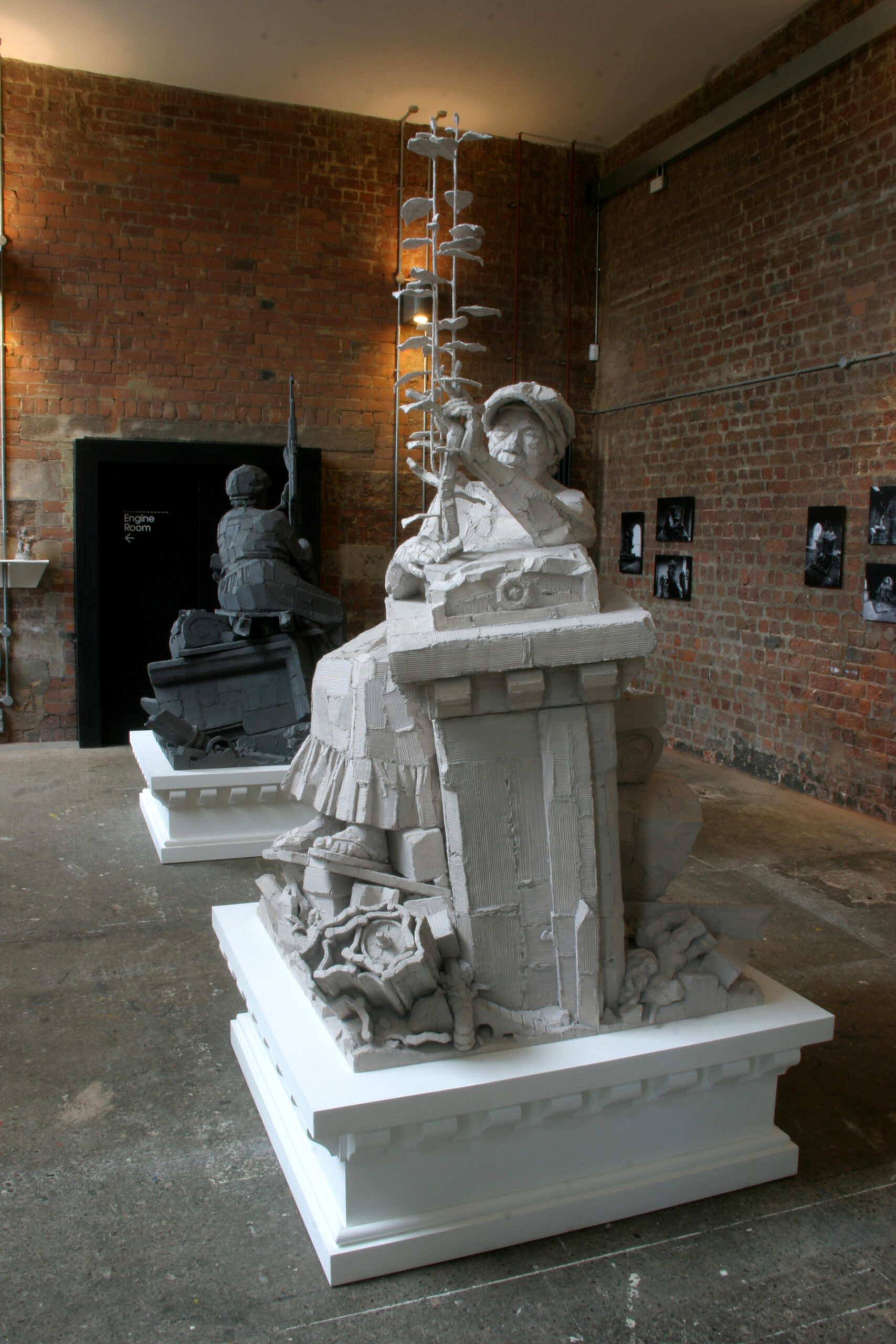
I’m showing it alongside my own life-size sculpture of Sue Lee. It deals with the regeneration of Kensington on a literal level – the piece is partially modelled on demolition debris collected from the area, as well as allegorically commenting on the pros and cons of change more generally. I made an allegory of death and destruction where she’s holding a Kalashnikov, alongside an allegory of life and creation where she is holding a branch stump with leafy shoots growing out of it; two opposing ideas about how regeneration can bring death and/or life to an area.
The rest of the show works in a similar way; pairing my own works with works from the Williamson’s collection that explore similar aspects of the portrait paradox, often with local contexts and resonances. It’s telling a local story.
A slight tangent, but I wanted to ask you about space. Do you think a lack of space contributes to a lack of sculptors working at this sort of scale these days?
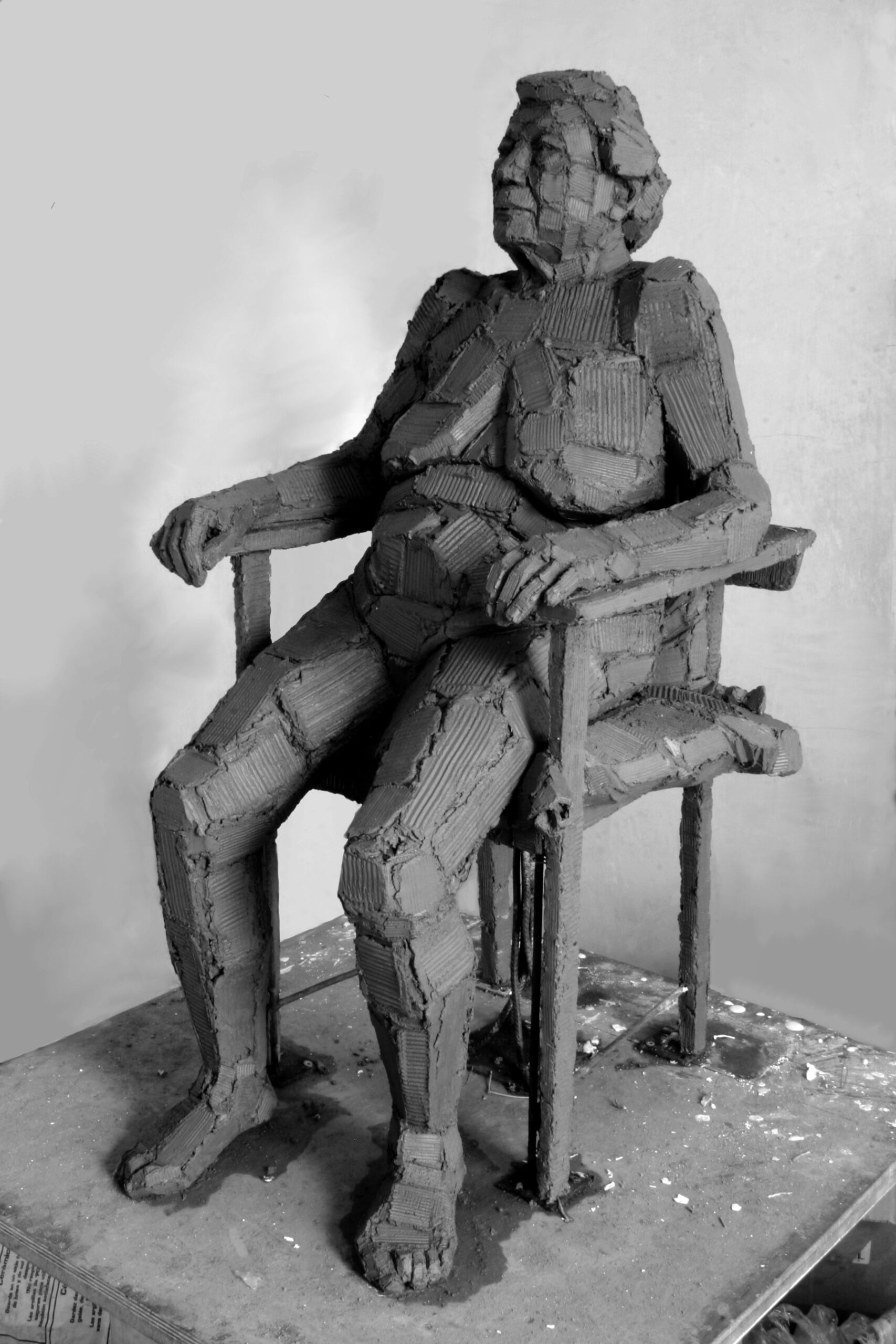
Originally the Sue sculpture was supposed to be 2/3 life scale as I was limited by a small studio, but Metal offered me a Time & Space Residency that meant I could make this to life scale.
Outside of these opportunities, you just have to scrimp on other things because it was pretty much full time project for two years and I just put everything else on hold while I was doing it. Paying rent for a big enough studio wasn’t an option.
Having a suitable space is definitely important, sometimes critical, but I haven’t been able to do something this ambitious since then, despite now having the space, as I now lack the time. Having time to spend on your art practice is probably the most important factor for artists, and this sculpture only exists because of a mixture of fortune and a very generous studio residency.
The exhibition itself is a chance to show work on this scale too, and to explore themes surrounding your work. What impact has that had?
It’s incredibly exciting. The collection expands the scope of the show, and helps to site my own work in the art historical context that’s led to it.
The works I’m referencing have been brought out of the Williamson collection. Some of these works may have never been exhibited before, others haven’t been exhibited for a very long time or in living memory.
The Williamson were very generous with the works I was allowed to select and their collection has a historically expansive range of work.
The Williamson’s works didn’t directly influence specific works of mine in the show (as I hadn’t seen any of them before curating the exhibition) but they do represent the same ideas that influenced me. Ideas around allegory, personification, facial expression, character, audience, material and process.
Are you looking at specific moments or movements to illustrate societal influences on viewing, or themes through art history?
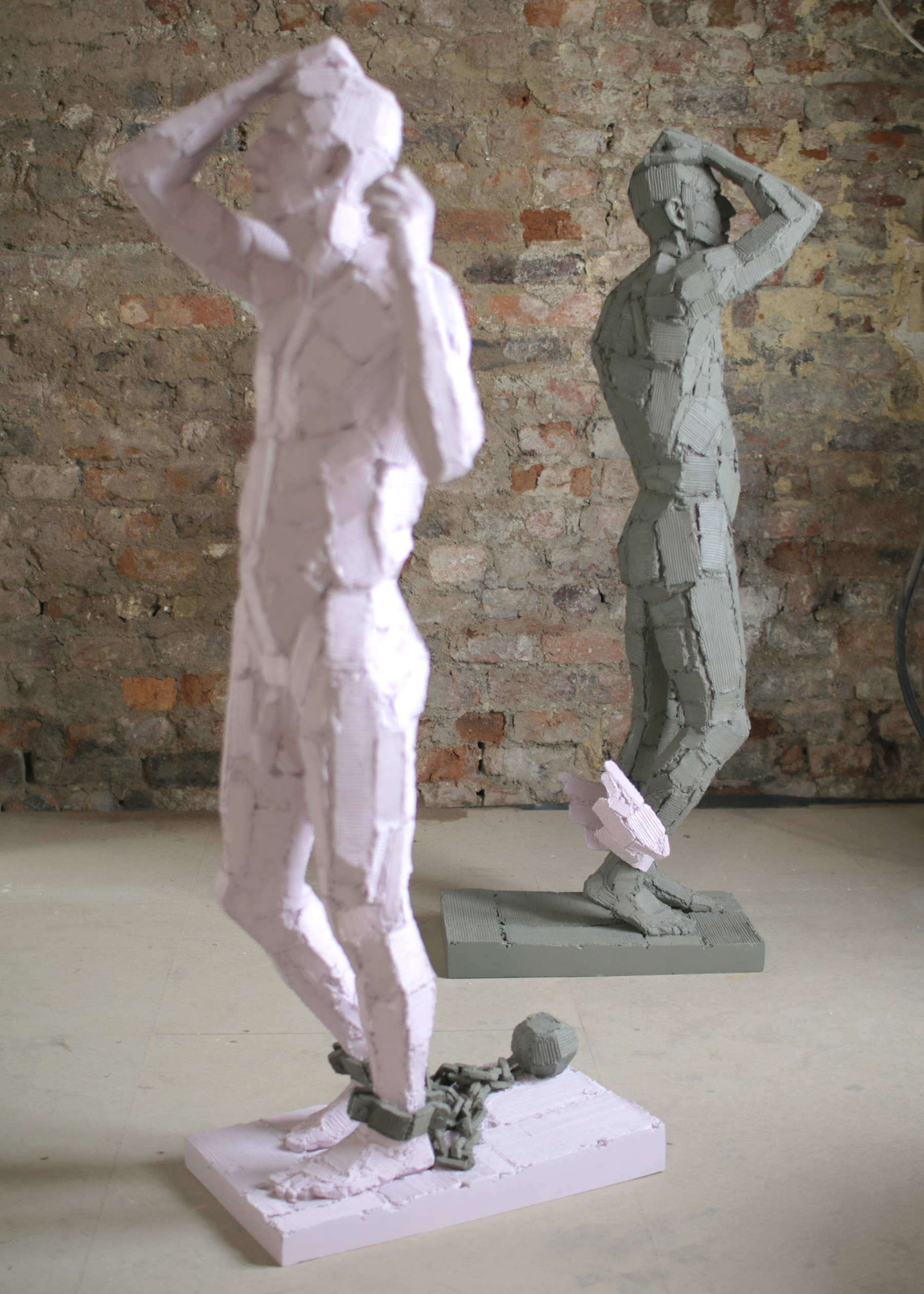
The pose of the only standing figure in the exhibition (‘Meme (Michelangelo-Rodin-Onslow Ford-Jeans)’) kind of tells that story.
His pose has a very long history in sculpture, starting with Michelangelo’s Dying Slave, which was the inspiration for Rodin’s famous ‘Age of Bronze’.
More locally, in the foyer of the Lady Lever gallery, there is a sculpture of a death figure by Onslow Ford. It’s a similar pose, and the artist explicitly says his inspiration was Rodin’s ‘Age of Bronze’.
I’ve now copied that pose again using a local Scouse model called Arthur, but these are Liverpool-specific iterations referencing the city’s slave trade history and international maritime port status with opposing allegories of enslavement and freedom of movement.
One of the Philip Wilson Steer painting’s you’ve referenced through the archive selection is incredibly worn. Was that a specific choice?
Yes. It’s ‘Mrs D. S. MacColl’ (1904). It’s in such a poor state. You can see all the paint cracking. My interest here is the material, and how the object itself takes on its own life after the artist has finished.
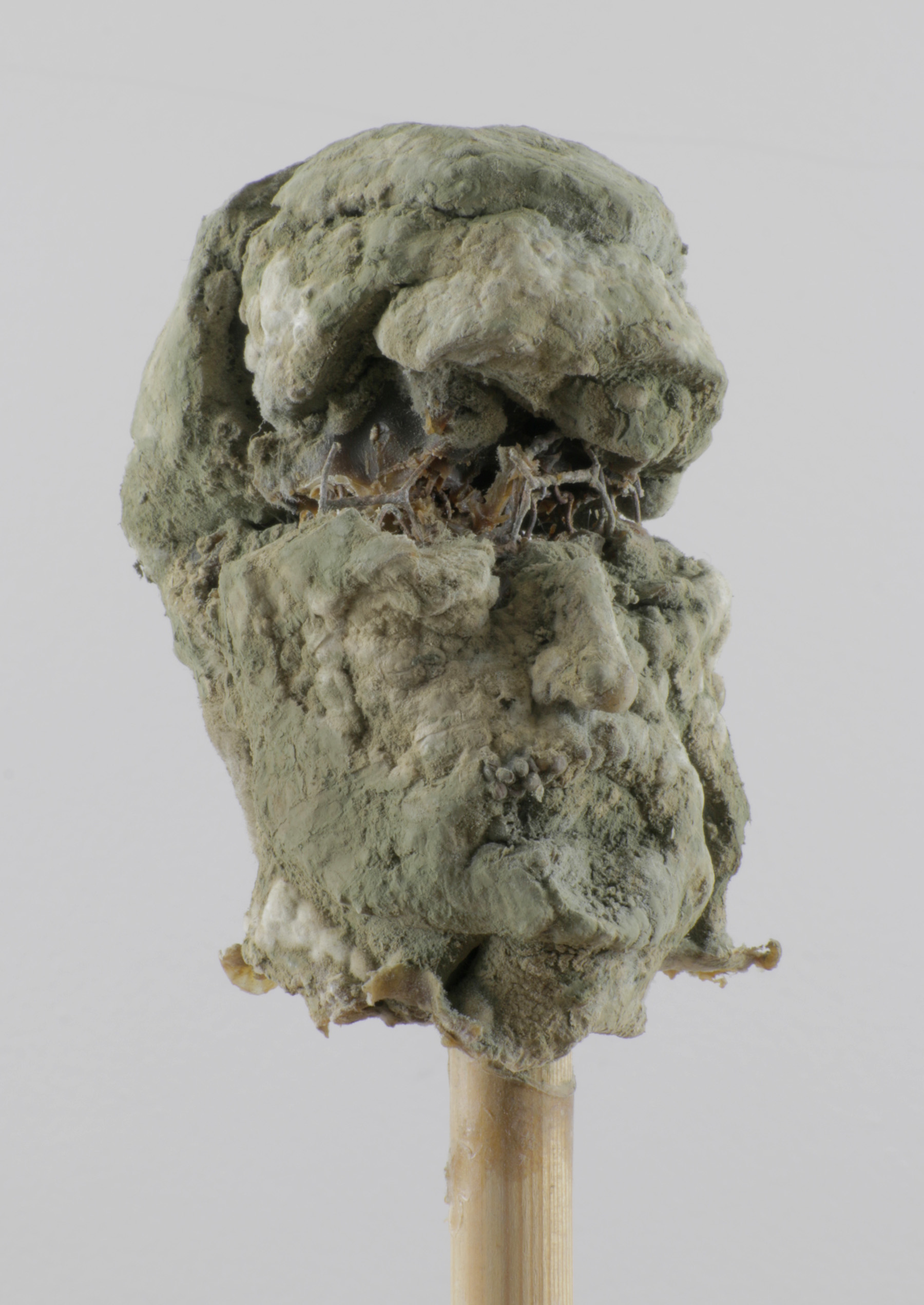
I wanted to use this in reference to my own work, ‘Living Head’ (2020), where I’ve taken this idea to an extreme by casting a head in agar jelly. That then grows mouldy, shrinks, changes, shapes, morphs into something very different, making the sitter unrecognisable.
It developed out of the conundrum that portrait artists have of trying to make an inert copy of a living person that looks as life-like as possible. But it can never be literally alive. Living Head actually becomes biologically alive as it starts growing mould.And in that process it takes on its own life, and its own characteristics. It develops into its own being, into something else beyond its original existence.
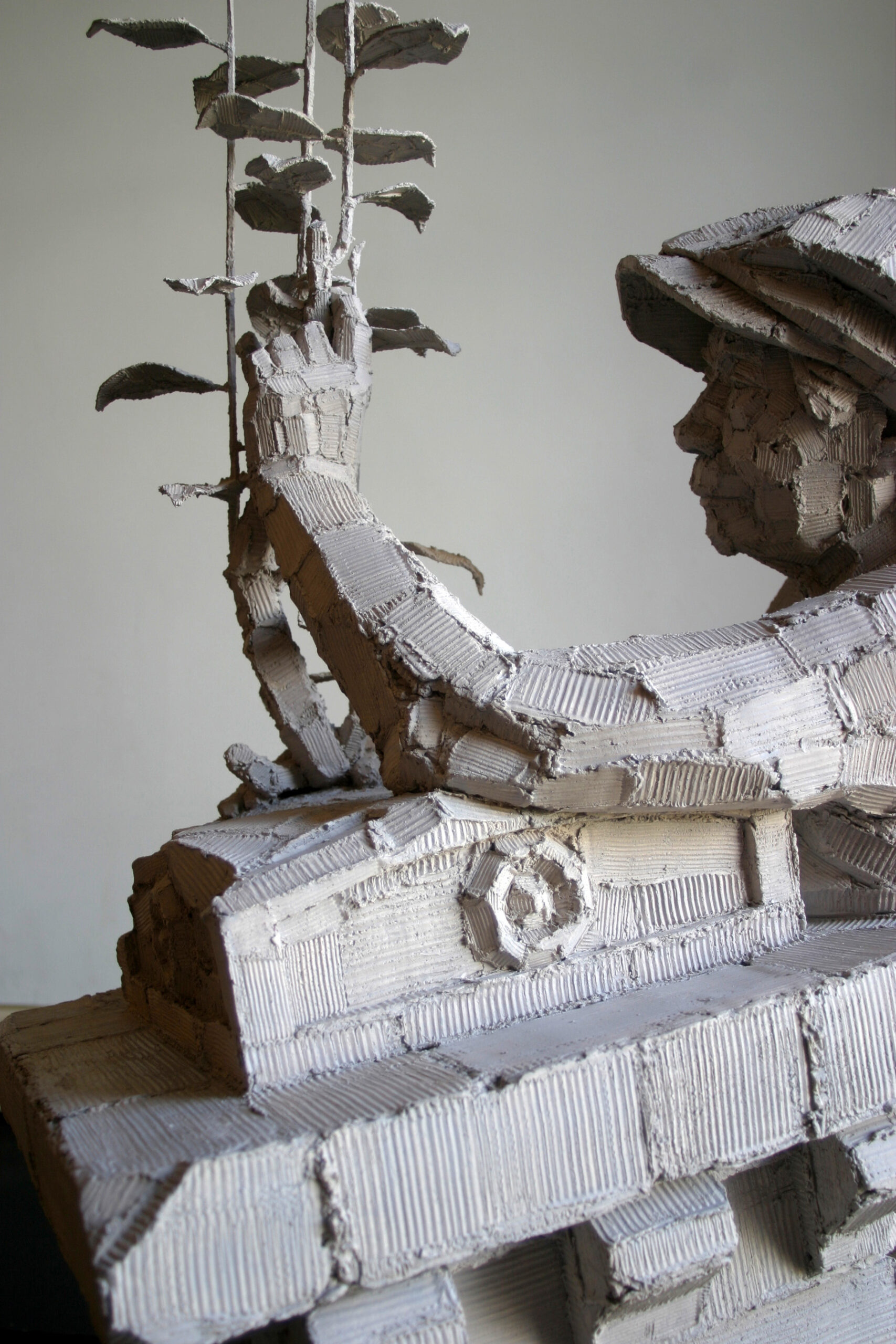
The exhibition is dedicated to Sue Lee, one of Liverpool’s best known life models. She died a few years ago, but you got to know her personally towards the end right?
Sue is a Liverpool icon. I met Sue when I moved to Liverpool through an art student I was talking to at a club. I contacted the college where she was working and they passed on my number.
Despite working full-time as a model, she would pose for me during her holidays, and for free. It’s similar to the issue of space we spoke about. Without that, I would never have been able to afford to pay a model for the weeks of sitting it took to make An Allegory of Life & Creation.
But we created something incredible, and life-sized, thanks to her generosity.
I heard similar stories from other artists about how she would buy art materials for students using her own money, or pose for them at weekends and during holidays.
We became good friends and when she did finally stop working and moved into a care home I’d regularly visit her. She would tell stories (often repeated!) of her very eventful and varied life as a mixed-race individual in Liverpool and Wales. It was an amazing working relationship and a good friendship as well.
—
The Portrait Paradox is at Williamson Art Gallery & Museum 14th Feb – 9th April 2026
Interview, Patrick Kirk-Smith