
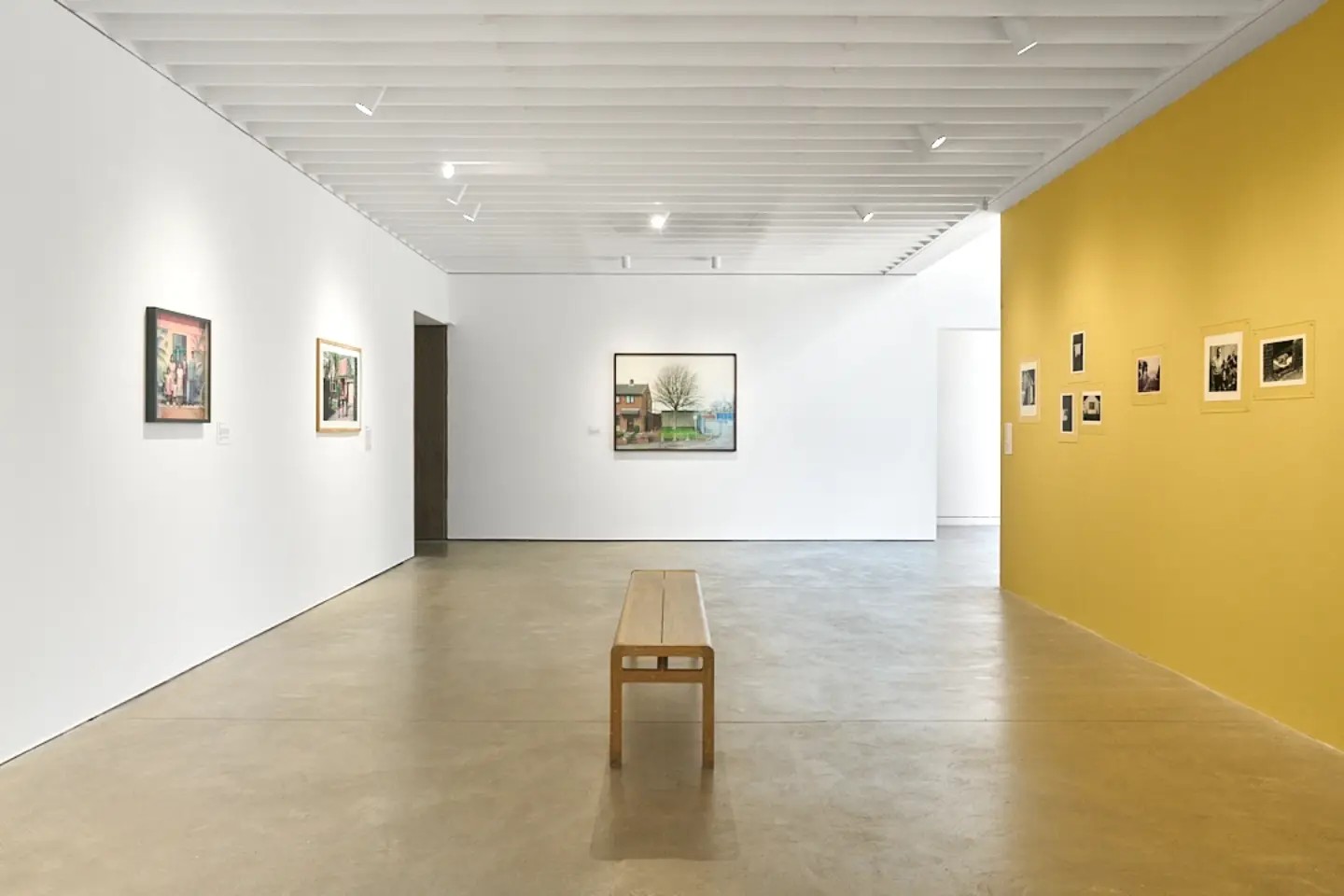
We’re writing this from an allotment, and knowing how often we like to judge the gardens of others. But that judgment is not negative, it’s to understand and find uses for other ways of using space.
We are of the unwavering view that gardens should be productive. What productive means in practice is unique to the user.
So in this text, there will be some discourse, often contradictory, often unruly, but it will offer us both a chance to reflect on an exhibition from the solitude of this garden, because this is our space, not mine or yours or theirs.
K: To be honest, I felt a bit lost at the beginning. The question was too big – like it’s justifying asking the question (I know you’re going to come to that).
P: Yeah, so is there a benefit to an exhibition asking whether something is a garden, especially when the answer depends on what you want the garden for? If the conclusion is just that “everything is a garden,” then what is the exhibition actually doing?
K: Well, obviously everything isn’t a garden. But what did that quote say? A garden is a garden when there is a gardener. It’s a space that is “gardened.”
P: That’s like some definitions of art, then, but I don’t think it’s meant to be drawing a parallel. I guess though – and I know we obviously do, but would you call the allotment a garden?
K: To us, yes. It’s a place for leisure, eating, and socialising (whether you like it or not), as well as work and design. To someone else, it might look totally unplanned or a bit scruffy, but compared to other plots, ours is a palace. It’s a working garden. It’s different from the garden at home.
P: Front gardens are a whole different question. They are usually meant for show.
K: They can be quite soulless. Ours isn’t for show. At all. It’s hidden by hedges and does its best to keep people out. A lot of front gardens are just a bit of lawn and some pots for curb appeal because people don’t really spend time in them these days.
P: Some people still have traditional productive front gardens with vegetables, like that one on Bluebell Lane.
K: The exhibition is also criticizing things. Think about how many people call a concreted driveway, with no soil or drainage, a front garden. On my mum’s road, there’s a stretch where the curb is dropped for every house because they’ve just turned the gardens into car parks. They look out their windows and just see the backs of vans.
P: It’s environmentally horrendous, but if a space has been landscaped with flags and concrete, isn’t it technically gardened? There have been gardens at Chelsea Flower Show that are just concrete with one plant.
K: If it’s got a car parked in it, it’s not a garden.
P: Ours has a car in it… anyway, remember that photo of the house with the bench onto the pavement? The front door looked boarded up, but the garden was like a community space. It’s 100% a garden, but it’s also 100% not private..
K: Then there was ‘Jack’s Handstand’ [Ellie Applegate]. That classic family space with a birdbath, goalposts, and grass. It’s a properly typical British garden. You’d offend most of Britain if you said that wasn’t a garden.
P: The problem with an exhibition like this is it forces you to be judgmental. We’re looking at these as gardeners and gallery viewers, but it’s unusual to be asked to judge spaces that people clearly love.
K: I guess it’s easier to ask this question about exhibitions because you’re kind of invited to, but questioning the validity of a garden just feels mean.
P: OK, well remember the ones that we maybe looked more positively on because they were in the gallery? Like we’d have never looked at them as gardens but they’re on borrowed space?
K: Yeah, ‘Fuck off’ [Andrew Langton]. The house had taken ownership of a bit of council land. It was like where we grew up – right next to an electric box that used to get full of fly-tipping. They are mowing it and they’ve put up homemade-looking bollards.
P: There was even a “No Tipping” sign. They’ve taken responsibility for this wasted land to protect a tree and stop fly-tipping. Most people wouldn’t call it guerrilla gardening – it’s not seed bombs or wildflower – but they’ve laid a lawn and they care.
K: There’s pride in that. And we probably wouldn’t have looked twice at that sort of space outside the exhibition. But then there was the balcony photo…
P: Oh yeah. The judgey moment – the intro text makes me feel like I’m meant to question if a balcony is a garden, which I don’t like. Of course it’s a garden. If you lived in a flat and only had a terrarium, that would be your garden. I know it’s part of the critique of classism though, and it’s context for that, but it’s like if it’s in this exhibition I’m meant to be second guessing it.
K: The effort they’ve gone into with those hanging baskets and the little wheelbarrow planter is beautiful. You can see they care about the space around them, too. It’s very English.
So that was a snapshot of a discussion that lasted about an hour and a half. And, honestly, didn’t really go anywhere, but the overwhelming sense was that there was something quite profoundly uncomfortable in the suggestion towards questioning if something is a garden, knowing that someone cares for it.
The context for the exhibition was clear though, are these tastes and judgements based on class? Culture? Something else? Yeah, probably. But there’s also a genuine value in encouraging change in gardens, because around 42% of domestic gardens in the UK are paved or hard landscaped and that’s actively bad for the world.
Final take?
P: I feel uncomfortable and mean, but I don’t want to stop talking about it…
K: I feel like it’s probably genuinely useful to have the conversation. People coming in to this with concrete space start to understand how minimal change needs to be.
—
If you too would like to argue (enjoyably) with someone for over an hour, take them to see Is This a Garden? at Open Eye Gallery until 31st August