I’m not actually sure I can say anything about Zahed Taj-Eddin that would offer, in even the slightest way, something useful. He knows his craft, intricately, and his subject probably even more.
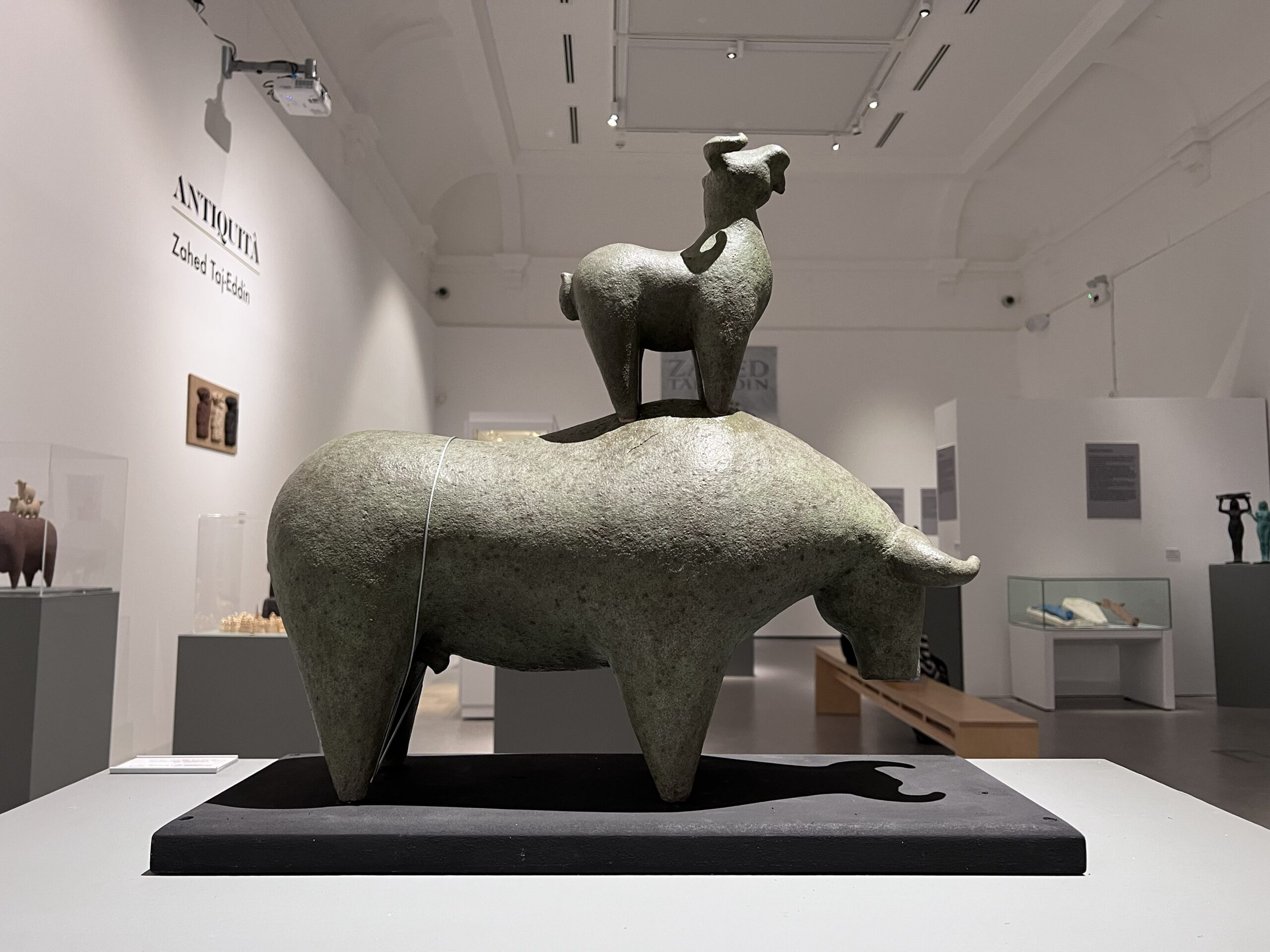
So, rather than trying to deconstruct this breathtaking collection – and it is a collection, I’ll get to that – I’m probably just going to talk about the raw reaction to these utterly beautiful sculpted beings/icons/tokens/stories.
First, these materials are just eye-catching. The clay itself is uniquely beautiful, and the bronze work is precise but lifeful, but the faience is something else.
Typical faience, the ultra-metallic stuff often seen in UK collections, is a finished, glazed clay, re-fired in oxides for an impressively shone finish. Traditional faience, Egyptian faience, is what gives that it’s name.
The material is made up of crushed quartz, lime and plant ash, rather than clay. When fired it creates its own glaze, and boasts being the oldest fired ceramic material on earth.
Nu Shabtis are the highlight of this exhibition, largely because of that material, but also because of their explicit politicisation of the material.
Exhibited at the V&A before their visit here, alongside genuine Egyptian Shabtis, these ‘Nu’ (new, liberated) Shabtis carry hard hats, bags for life and mobile phones, alongside protest placards calling for a free Syria.
The minute placards, featuring Assad with blood on his hands were first exhibited in 2013. Their continued exhibition today, as the former president lives in exile, reinforces the power of global protest these sculptures were part of.
In ancient Egypt, these Shabtis were placed in tombs as servants to the dead, to carry them through the afterlife. Zahed Taj-Eddin here imagines them released from those tombs to find the modern world as it is. No underworld, no master to serve, just a potential but unrealised freedom.
It is essential that they have been crafted in traditional faience, not just because it’s true to this story, but because it literally stops you in your tracks as a material.
Taj-Eddin’s approach here is to create a modern take on forms, materials and motifs used in ancient Egypt, resume ownership of them, and build new collections. The outcome is something that unsettlingly straddles museum and gallery, speaking with the authority of an historian but the tone of an artist. And that is really quite spectacular
—
Zahed Taj-Eddin: ANTIQUA is open at The Atkinson, Southport, until 10th October 2026
Words, Patrick Kirk-Smith