
One introduction to the Listening All Night in The Rain, written ahead of its screening in Venice in 2024 by British Pavilion curator Tarini Malik, offers a useful way into this film, which many will pass as a monument rather than a story. John Akomfrah’s intention, according to the curator, looks to “reposition the role of art in its ability to write history in unexpected ways”. There’s more to that quote, but that’s a good summary of why this film is the way it is.
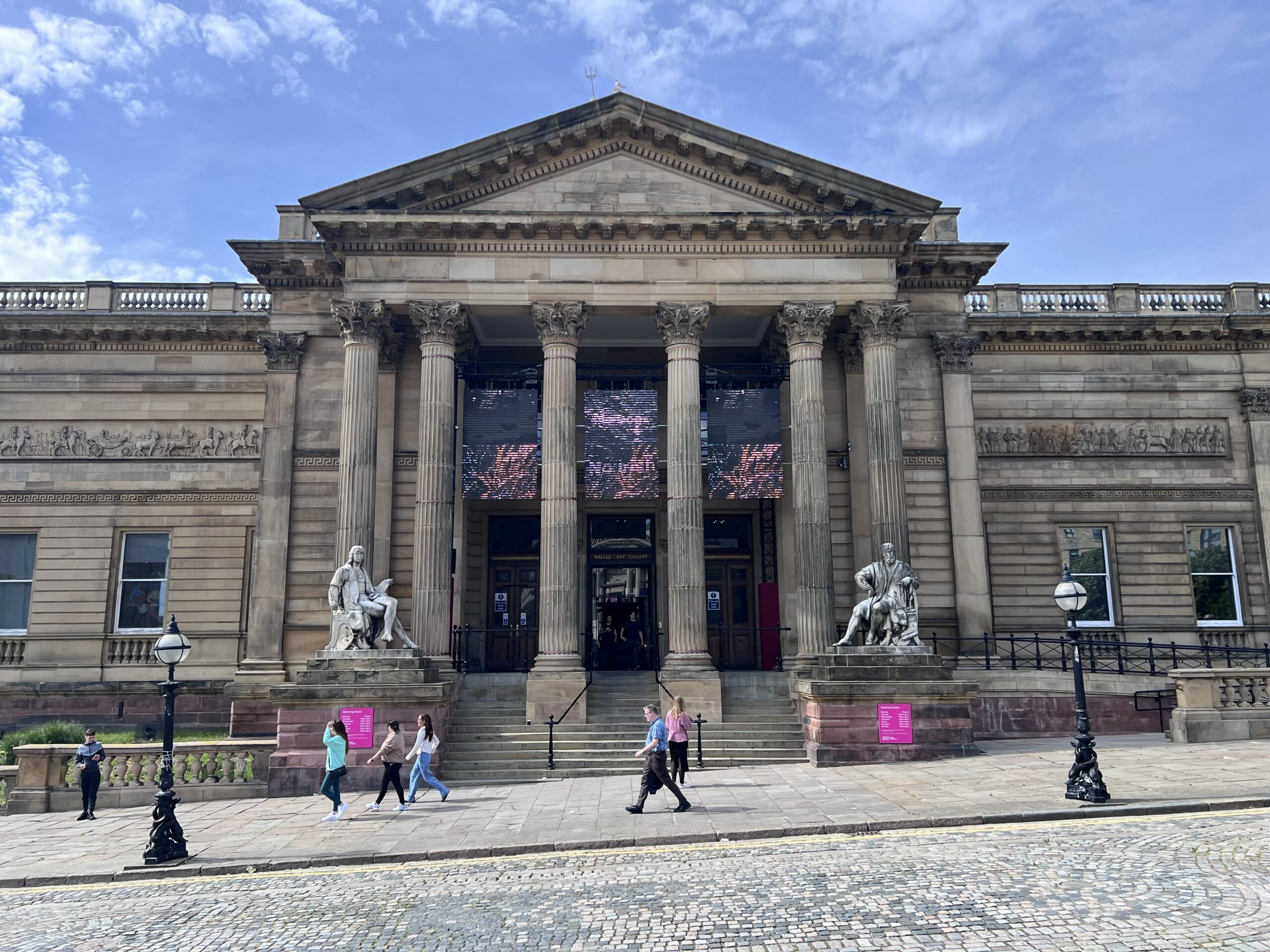
Outside the gallery, a three-channel display plays bassy audio that bleeds down William Brown Street. It’s actively pulling people up the hill.
When you get there, in a crowd – at least half clearly hadn’t intended to stray to the gallery – it is really quite monumental. The first reaction is more shock and awe, seeing this contemporary triptych ambitiously stretched across the front of the Walker. The second is wanting to spend more time than you have here. The third is whether you decide to venture further.
The film is built of found archival footage, and occasionally injected with new work, shot specifically for it. Because of that it feels historic, it feels educational. For so many potential audiences (potential for this work, potential for this gallery, potential for art in general), this feels familiar; museological. Because visiting galleries isn’t necessarily something they’ll trust, but museums are known. They’re factual. Objective, and unjudging.
If Listening All Night in the Rain is supposed to “reposition the role of art in its ability to write history” then this is a strong approach to “unexpected ways”. Because it’s not only writing history, and introducing essential themes of racial injustice, and Britain’s role in that, it’s offering it as fact in a way people are familiar with receiving facts. It removes almost entirely the ability to argue with the statement of the work without offending those who would disagree.
It is genius for that. And whether others take the next step into the building or not, hearing the voice of one of Britain’s most respected Black artists tell their story on this scale will have had influence.
London-born, but with a deep understanding of the UK and its responsibilities, Akomfrah is also familiar with Liverpool, and the context this work will be understood within. Water flows through the entire work, visible and audible in nearly every frame. Flashes of text that most state curriculums still present as closer to South African apartheid than 20th century. Much of this is living memory, some is generational, and some is so deeply embedded in Black British culture that it’s often gut wrenching for White Britons to grasp what they’ve missed, forgotten or had erased from their own legacy.
‘No blacks, no dogs, no Irish’. Flashed in and faded out from the screen under a wash of tidal water, the same tide that washed boats and bodies to shore; cargo then, criminal now.
If you’re in any way questioning the intent of the artist, or the value of the work, I would just encourage you to visit this while it’s here, in a city whose waters are a lasting echo of so much of the fault of colonial rule, which fed the supply of slaves to the world, and which presented stories of profit and affluent societal gains from the colonies so that we, centuries on could feel the need to reject our own genetic gain, because time passed.
And that’s just there, 50ft tall, on the side of one of the city’s most iconic buildings, presenting as artefact, but showing as art.
John Akomfrah is a monumental storyteller, and this instal matches his stature. The real test is what impact it has on you, and those other strangers pulled up the hill to the noise.
—
John Akomfrah: Listening All Night in The Rain is on display outside Walker Art Gallery until 31st August 2026
Words, Patrick Kirk-Smith