Kim HwaHyun’s exhibition visits literary structures, fictional tropes and deep seated biases to present a proposal for identifying and celebrating the unseen queer communities of South Korea.
The phrase I focussed on in the exhibition text was “she restores queer communities to a canon that historically denied their presence”. Canon. It’s so indelibly associated with fictional, fantasy and sci-fi, that the word itself can’t have been a mistake. It can’t. The artist, for every step of this exhibition shares her proposals for a better version of representation with impeccably considered materials, stylistic tropes, and a blend of figurative and activist aesthetics.
So to suggest that queer culture has been deleted, retracted, or omitted from the canon of Korean culture, is to suggest that there is a conscious, deliberate re-writing of history. And, as it turns out, strongly evidenced in exhibition reading, that evidence is abundant.
The culture we’re being shown, the version of K-pop we see and hear, the films, tv-shows and cultural histories do, actively, remove not only the stories of queerness and homosexuality, but the safety to exist within that part of Korean culture.
A quote from Park Hyung-Jun, Mayor of Busan, included in the catalogue: “I am fundamentally and strongly against homosexuality.”
That sentiment echoed by other political leaders:
“The anti-discrimination law contradicts the biblical worldview and creative order that God created for men and women.” – Ann Chang-ho, Chairman of the National Human Rights Commission of Korea.
The quote above act as prompts for the exhibition, but also for the thinking behind the wider programme. For Kim HwaHyun, they are an opportunity to assert a radical idea of androgynous gender within traditional Korean story-telling devices.
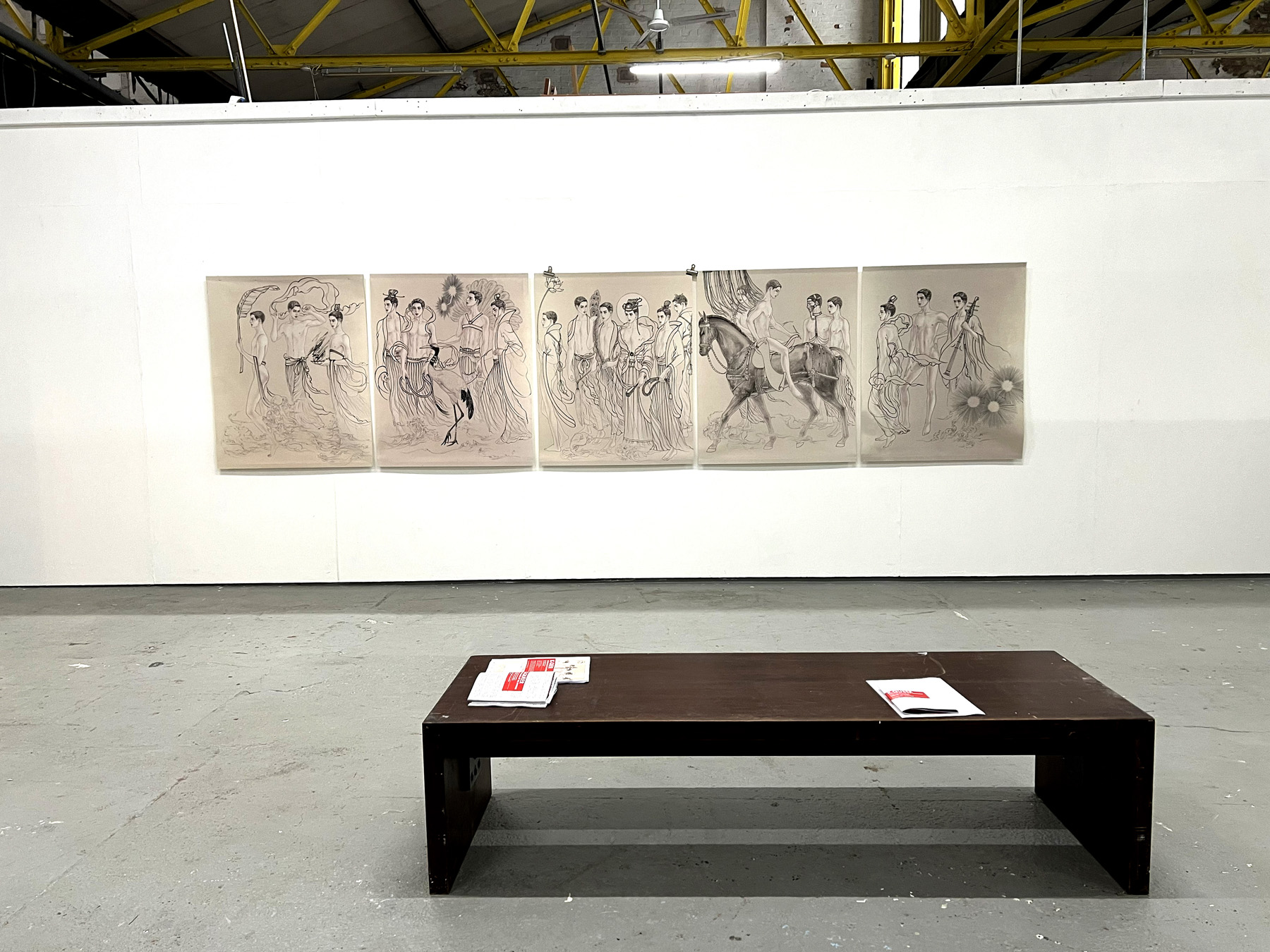
The March of the Immortals (2017) is a delicate portrayal of a traditional Daoist deity procession. The materials are appropriate; the illustrations are stylistically correct. The subjects are, however, reimagined as the focus on a drag parade, fronted and contained by traditional imagery, in clothes purposely androgenous.
This is K-culture without the censure. It’s so blatantly representative that it barely needs the cut out text adoring the opposite wall, but that, ‘Georges: a statement’, ensures you leave, knowing this is a subversion, not a celebration, of K-culture.
The exhibition is part of a wider programme, including film and literary talks across Manchester, Lancashire and Liverpool, all ending 31st January.
The programme is curated by Ryu Jaewook, a scholar and lecturer of South Korean Studies at the University of Central Lancashire. His work focusses on queer Asian film and the Politics of Korean Queer Cinema. Working in collaboration with Nilesh Kumar, a British-Indian curator based in South Korea, the pair combine their power of their research, and unique cultural junction, to heighten the voices of queer Korean artists, filmmakers and writers.
—
K-Queer: Intimacies of The Invisible, 24th-30th January at The Royal Standard
Words, Patrick Kirk-Smith