
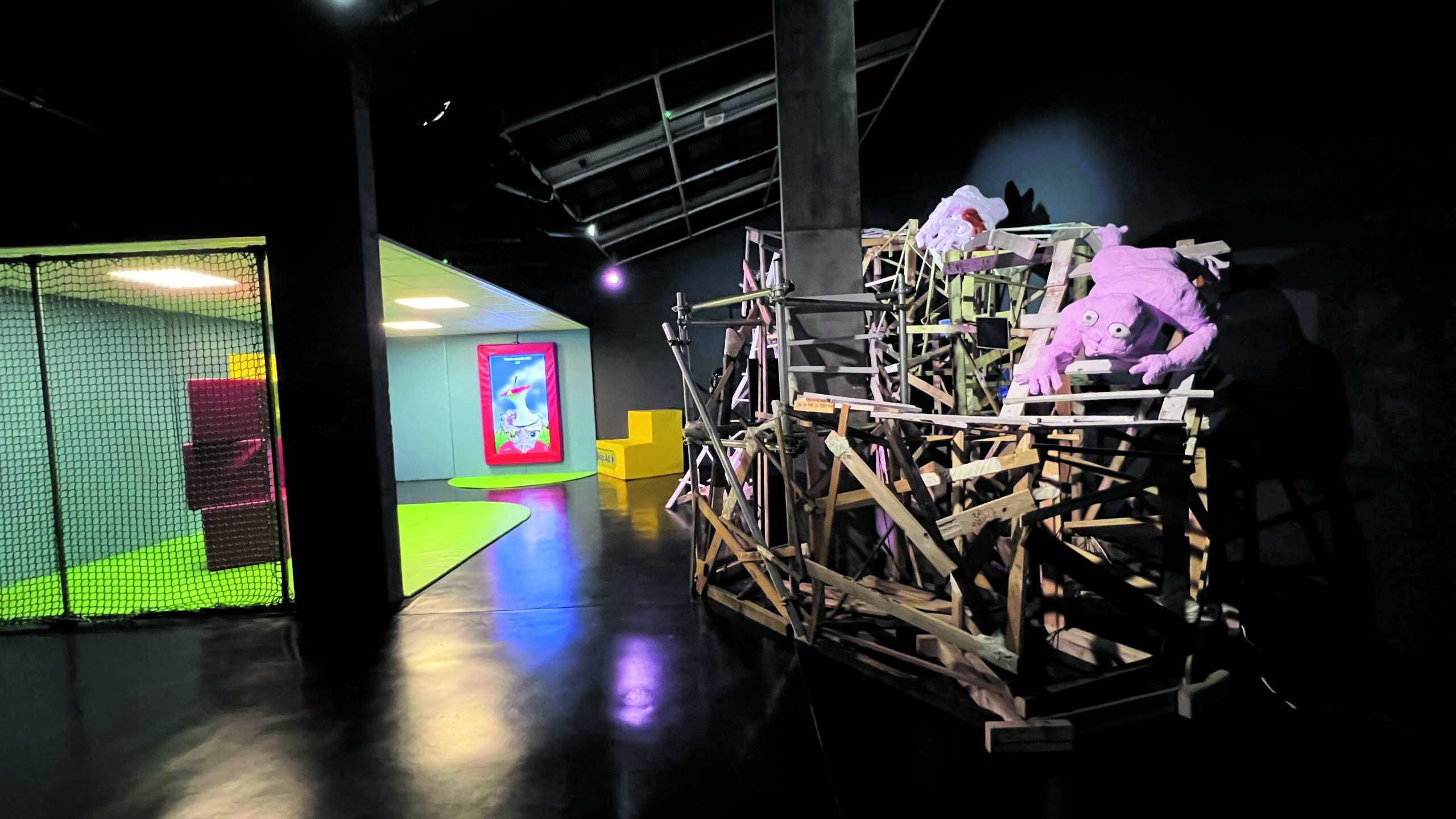
Mania, restriction and fear are the key words for BRB at FACT. On its face, the exhibition is approachable and chaotic, but deep down it’s the exact opposite.
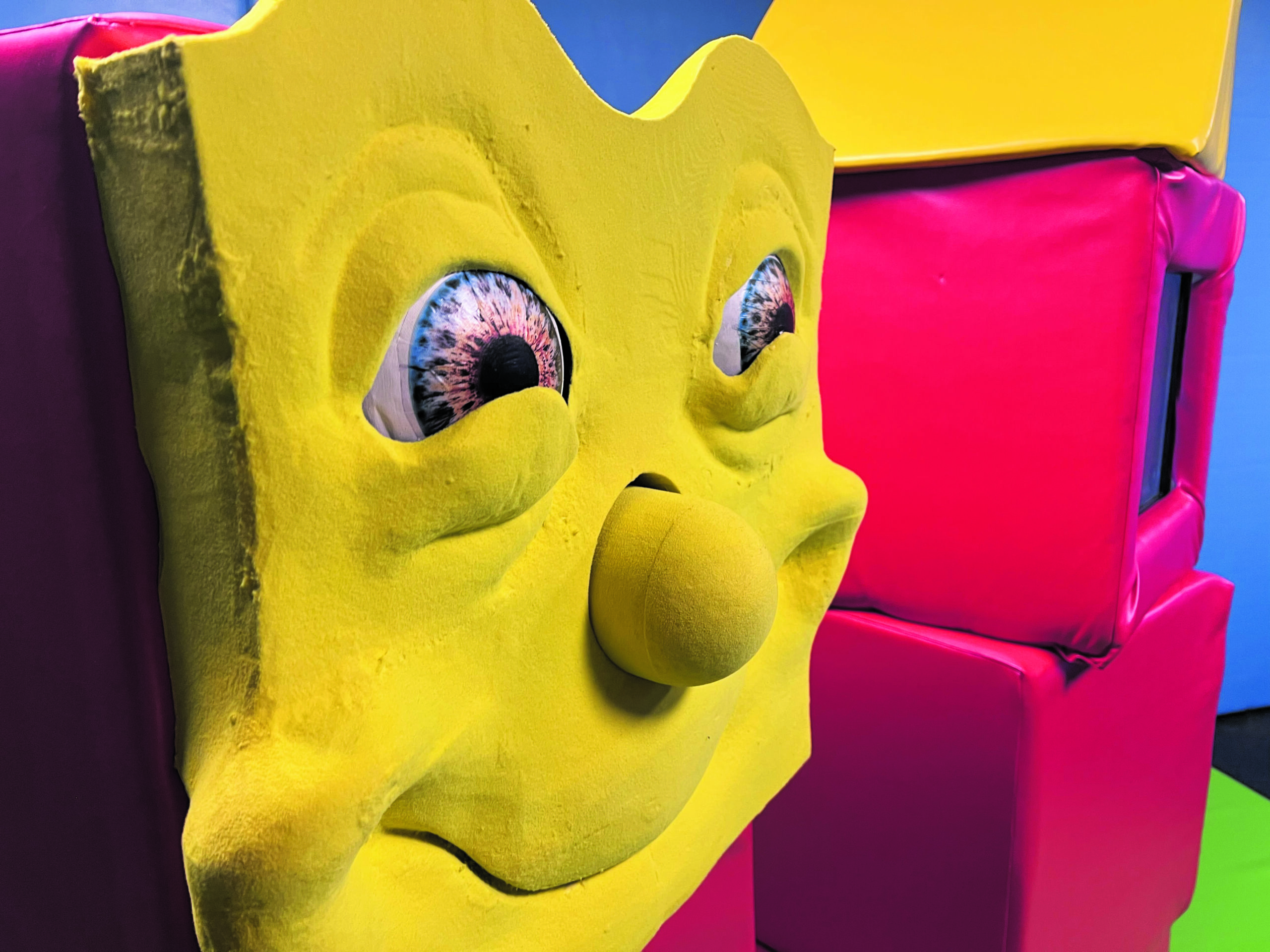
Padded Cell, by Livi Wilmore thrives in this space. Paired with disarming new work by Ellie Hoskins and Mrs Luva-Luva, the literal padded cell, draws on the early domestic personal computer landscape designs and the welcoming cage of padded cell interfaces developed by Kai Krause.
The theory behind it powered the design of most 90s and early 00s websites and installable computer programmes. It was designed to be user-friendly, and give freedom of use, while restricting opportunities to break stuff, find bugs, and basically just keep your experience of everything as smooth as possible.
But it also meant the world became more uniform. When Photoshop launched in 1987, it was technical. You needed to know how to use it. By the time padded cell philosophy had taken hold, and most internet users were working with some sense of those restrictions (gladly, because it made it accessible), new photoshop users wanted that too. Kai’s Power Tools, a premium plugin that could be purchased alongside photoshop, essentially made the entire interface more intuitive. But it also meant that nearly every output followed the same visual base.
Eventually, it became a sign of bad design, and lazy workmanship, in the same way that AI generated event posters make a game of design – so much so that its barely even a commodity.
While Kai Krause’s interfaces aren’t directly part of how we use these tools today, they laid the groundwork for user restriction, and the addictive nature of tech.
Livi Wilmore’s ‘Padded Cell’ installation highlights how this user-protection [sic. restriction] is no longer a choice. It’s built-in to keep us plugged in because, like AI interfaces, human UI designers have learned that we are more likely to use things that don’t feel like they can hurt us.
The more immediate creepiness in the exhibition comes from Mrs Luva-Luva’s ‘Tap Tap Tippety Tap’, which presents a narrative of a woman so emotionally vulnerable online that she became a homogenous lump of flesh. There’s a self-reflection here from the artist, who jumps from one medium to the next, because “working in a single form no longer feels enough to capture the fractured and accelerated world we inhabit”.
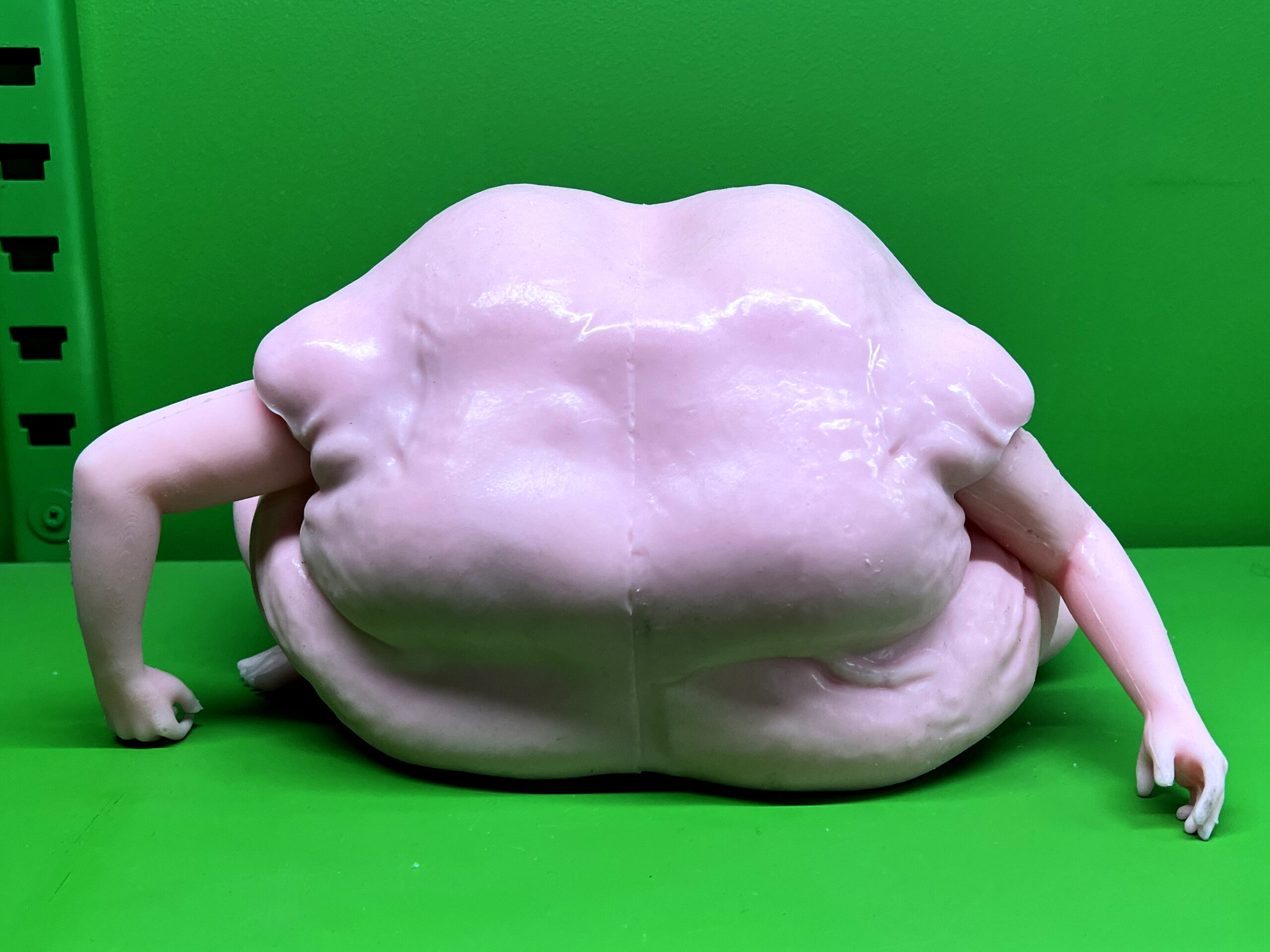
The work is emotionally disturbing, and visually unsettling. It extends more on the condition that results from the world created by what Livi Wilmore explores. Specifically, what the outcome of personal identity could become, when it is fed into a system designed to be usable for the sole purpose of gathering data, and how you, the user, keep using it because it is just so damn addictive that you forget to care that your life is being harvested. And, if you keep on down this road, your entire personality could be reverse engineered by the algorithm you thought you were in control of.
If that’s the fear, and I might be wrong, there’s a assertation that that same padded-cell user interface could be creating humans so lacking in uniqueness that they begin to look like 1990’s websites. All bevelled circles and no filter.
That commodification of self and the fear of losing yourself to internet culture, is brought to life in the depths of Ellie Hoskins’ ‘Alive in a world of car parks, armed with an air fryer and a fake baby’.
The work is unsettling, like the rest of the exhibition, scrawled with burned graffiti that starts as a playground joke, and becomes an existential inner crisis by the end of the rollercoaster (it’s an actual rollercoaster as well an emotional one). “Yer ma hoovers crumbless floors” quickly moves into darker jabs: “Yer ma can’t bear to remember certain things”.
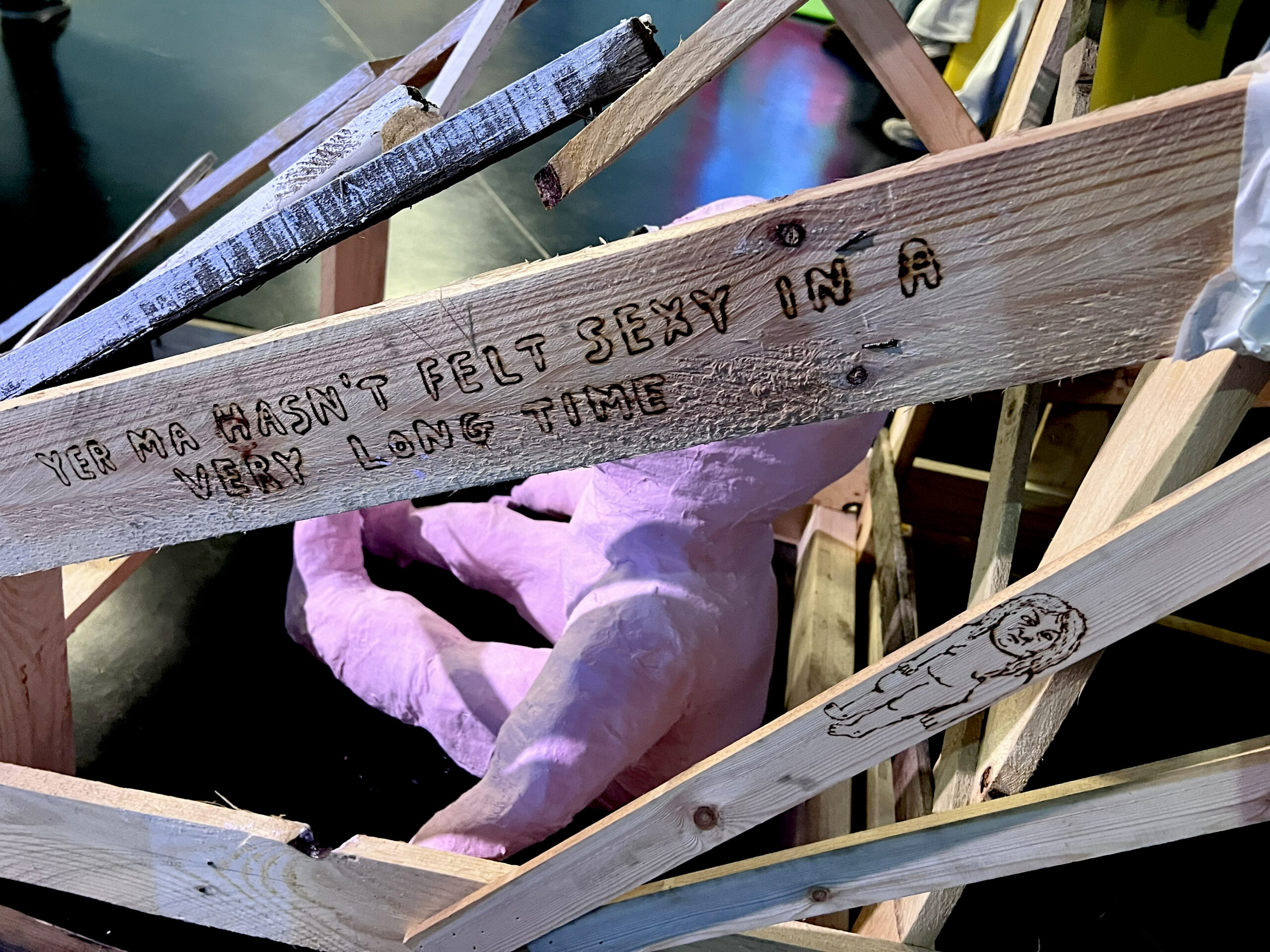
It’s important to say that the baby here is fake. The relationship is imagined. It’s imagined in a fearful world, where air fryers and consumer goods have become part of lifelong relationships.
Unlike Livi Wilmore and Mrs Luva-Luva, Ellie Hoskins isn’t focussed on tech, AI and the advancement of engagement in screen media. This is on everyday consumerism. How it shapes us.
How it distract us, and the loneliness it instils becomes part of us.
That all takes place, from the scaled-up Modroc bodies to the deeply depressing poetry, across a sprawling, dilapidated rollercoaster that just doesn’t go anywhere any more.
You probably won’t feel better about yourself after BRB, but you might feel ok about that.
—
BRB: Ellie Hoskins, Mrs Luva-Luva, Livi Wilmore is open at FACT until 6th December 2026
Words, Patrick Kirk-Smith