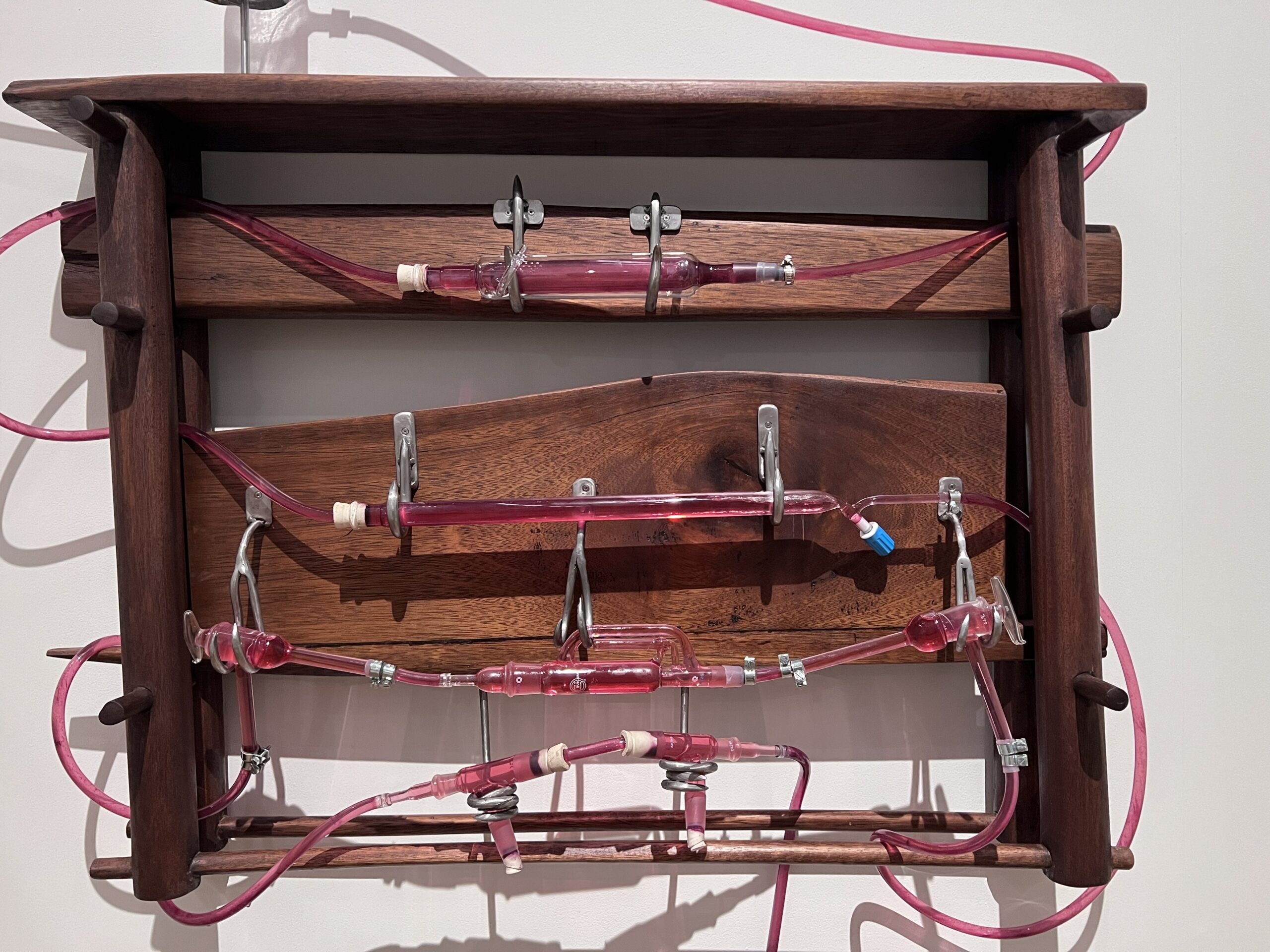
‘What if You Regret It?’ asks Charli Kleeman, whose work exploring DIY hormone production, and black market hormone sourcing greets you when you walk into this striking affirmation of the right to live your way.
The kinetic sculpture, pumping hormone replacements in fluid form through transparent tubing, in and out of a richly varnished timber gun rack, is a compact version of what was shown at The Stables in Port Sunlight, thanks to Ghost Art School, during Independents Biennial 2025.
In both iterations the message is the same, that this very specific representation of masculinity, further reinforced by the private gyms these hormones are often sourced through (due to various factors including poor legislation but also judgement undergoing gender reassignment through the NHS or official prescribing channels), is hard to escape, but not necessarily where you want to end up when transitioning female to male.
It is a simplistic but not incorrect view of masculinity, in that yes that exists. One way of being male is to be traditionally alpha. It’s a valid way to be. But it isn’t the only way to be, and it should in no way be assumed that that is the target of any trans person undergoing reassignment.
Charli Kleeman’s work here is an introduction to a joyful, proud, exploration of gender and what it means to the artists exploring it. The prefect introduction to a blend of ideas on gender in an undeniably traditional venue.
Through the rest of the exhibition, works from the National Museums collection are played off against one another in a vibrant conversation about gender roles and their representation through art.
‘Motherless’, an 1883 oil painting by Arthur Stocks shows a father holding an infant child at the grave of their mother. At the time this work likely spoke to elevate the ability of the father as a sort of public reassurance, while affirming the role of the mother as the primary carer. The wall text here establishes that those roles persist today. But the reading is different now, perhaps more significant, in that those roles in caregiving are more prominently discussed and dissected.
Yinka Shonibare’s ‘Untitled’ (Dollhouse)’ is a replica of the artist’s home in East London. His reflections on that space span an entire identity, but also invoke a common view that dollhouses are toys for girls. They teach gender roles and instill a joy of housekeeping at a young age. There is absolutely no problem with that as a function of a toy. The problem comes from assigning a gender to it, where that fascination for life scaled down is completely genderless.
Much of the rest of the exhibition highlights either very universal or very local gender issues – from Ree Bradley’s ‘The Mind is a Group Muscle’ which invited a group of men to explore the somatic practices of Re-Birthing Breathwork and art therapy, to the activist t-shirt by Protect Scouse Dolls, bearing the same slogan.
It is a completely exploratory exhibition, affirming the right and decisions of individuals, encouraging conversation and offering space for it. In a region where St Helens cancelled Pride (only to be showed up by a voluntary movement instead) and have removed LGBTQ+ publications from display in libraries, only to rapidly realise it contradicted every freedom of speech and information platform the newly elected Reform council have stood on, this exhibition is essential.
Seeing the exhibition a few hours after a news report on the significant rise of misogyny in young men in school settings makes the entire curatorial work here feel more alive, and more purposeful to all potential viewers.
—
Gender Stories is open at Walker Art Gallery until 31st August 2026
Words, Patrick Kirk-Smith