

When I was about 14, I started a small fire in a school cabin during a maths lesson. It wasn’t intentional. I was trying to hide some origami. I’d been fiddling with to distract myself down the back of an electric radiator. It was a small and insignificant moment, but the action highlighted my attention deficit, and from that day on I was treated fairly by my teacher, got the help I needed, and started to kind of enjoy lessons.
That isn’t even relevant to this exhibition, specifically focussed on intentional firesetting, but it is my starting point for understanding it.
The exhibition sets out describing firesetting in relation to the Firehawk (the Australian Black Kite), which has been “observed carrying burning sticks to new locations, deliberately spreading fire to flush prey from the undergrowth”.
That ritual of the natural world suggests that fire is not a uniquely human tool; that fire is an instinctive element.
So the second offering of the show has that foundation almost as its statement of intent: humans are engaging in fire setting to attempt some subconscious form of communication.
Held in two distinct series of photographs is exactly that language of firesetting; sometimes destructive, sometimes attention seeking, sometimes ritual, sometimes play.
The exhibition’s introductory film is a powerful tool for telling those stories, but it’s perhaps the carefully chosen words of writers on the walls that contextualise them.
“Among all phenomena, it is really the only one to which there be so definitely attributed the opposing values of good and evil. It shines in Paradise. It burns in Hell. It is gentleness and torture. It is cookery and it is apocalypse. It is a pleasure for the good child sitting prudently by the hearth; yet it punished any disobedience when the child wishes to play too close to its flames. It is well-being and it is respect. It is a tutelary and a terrible divinity, both good and bad. It can contradict itself; thus it is one of the principles of universal explanation.” – Gaston Bachelard, The Psychoanalysis of Fire
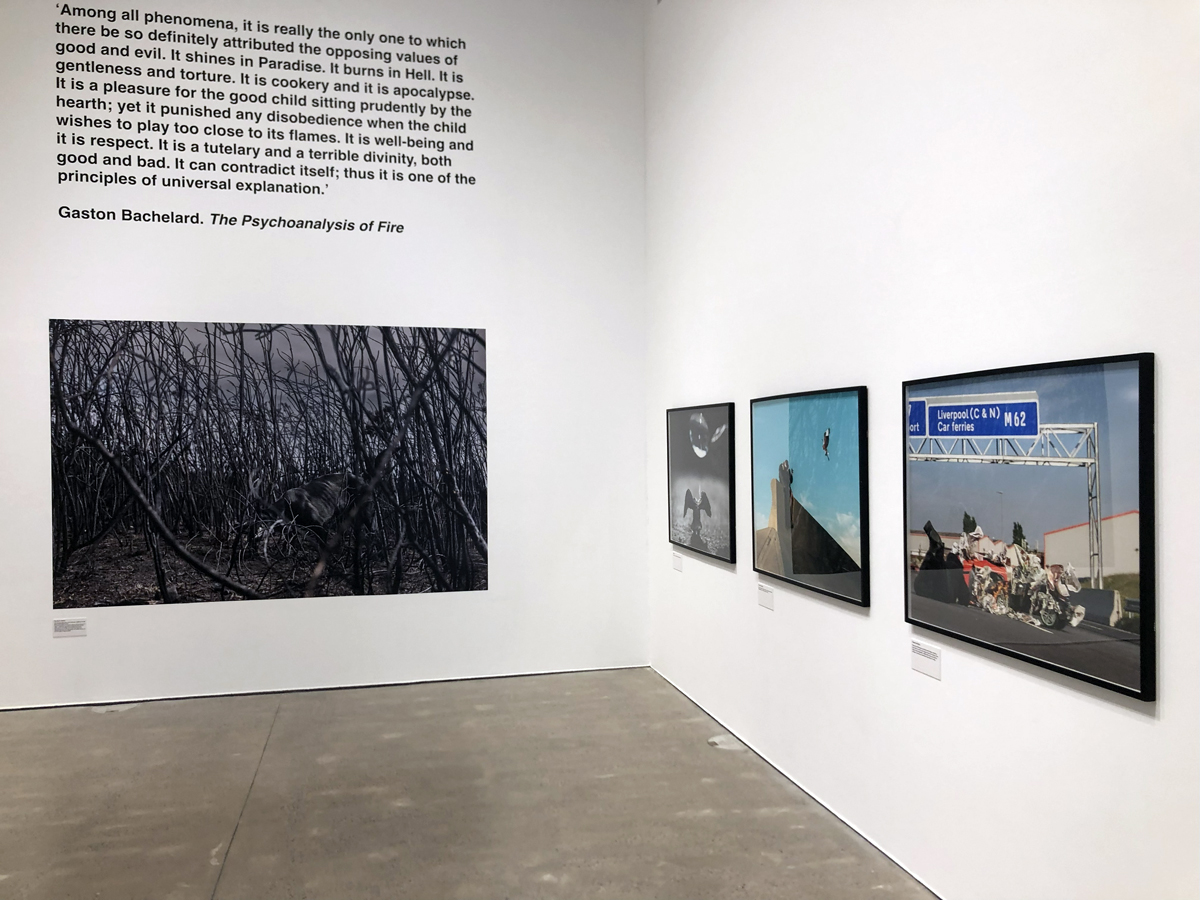
In one image, a bonfire built of crashed cars and newspaper at an industrial road junction is clearly destructive, but as an observer you’re encouraged to remain open minded over the reasons that fire was set, and the circumstances that led to it. In another, a family congregate at a campfire.
Firehawks is an exhibition filled with untold stories and prompts. It will resonate with so many thanks to the work of its collaborators, including Northumberland Fire & Rescue Service and Merseyside Fire and Rescue Service, who not only allowed this photography series to be compiled on their call outs, but offered insight into those children, young people and adults, who set these fires to help Stephen King build this exhibition. And outside of this, work to offer care and intervention to regular firesetters.
It’s a fascinating show, full of opportunities to empathise, whether or not you’ve got a relationship with fire.
Firehawks is open at Open Eye Gallery until 16th November 2025
Words, Patrick Kirk-Smith