Open Eye Gallery: Self-Defined. New Stories From Archives
Date: 17.4.26 - 7.6.26
Time: All Day
Location: Open Eye Gallery, Mann Island, Liverpool Waterfront, Liverpool, L3 1BP
Launch: 16 April / 6–8pm / Open Eye Gallery / RSVP
Self-Defined exhibition brings together the histories from the East (or Centre, depending on perspective) of Europe through the contemporary work of artists from different geographies working with local contexts and their own family stories. It explores non-institutional, independent, private archiving and the non-existence or inaccessibility of material memory.
The projects featured in the exhibition range from an exploration of post-WW2 family displacement in Poland, Germany, and Ukraine; to the history of the Crimean Tatars in the 20th century; to a decades-long photographic exploration of life in the Latvian countryside; from playful collages deconstructing Soviet tourist photographs to a speculative video dealing with the disappearance of the family archive.
Viktoria Bavykina, who curated the exhibition together with Open Eye Gallery’s Max Gorbatskyi, said: “This exhibition is the first attempt in our long-term work with photography archives from countries occupied or influenced by the Soviet regime, whose histories, legacies, and lives were shaped by years of totalitarian and imperial rule. During this project, which we hope to build with our current and future partners across Europe, we want to commission artists and photographers to work with their local private, public, and vernacular archives, reconsidering them from a contemporary perspective.”
“Mind of Winter” by Karolina Gembara is an exploration of post-WW2 displacement and border changes through the stories of families from Poland, Germany, and Ukraine, centred on Karolina’s own family history. She grew up in a Polish family that had been relocated from Ukraine, inhabiting the German-built house in Poland vacated by the German family who was forced to move to Germany. The work combines contemporary staged photographs that respond to past events and images from the archive.
Similar to Gembara’s work, Emine Ziyatdin based her project “Crimean Counter-Archive From Below” on personal archives and her own family history to raise the issue of epistemic injustice – namely, how knowledge about the history of the Crimean Tatars in the 20th century has long been constructed from Soviet and later Russian perspectives, strictly excluding authentic voices. Decades of deportations, persecution, and exile of the Crimean Tatar people continue today following Russia’s annexation of Crimea in 2014. This has led to a rupture in historical continuity, the destruction of family ties and cultural practices, and a diminished ability to shape and articulate their own historical narrative. Working with her family’s photographic archives, Emine reconstructs fragments of personal memory and gives voice to the experiences of hundreds of thousands of Crimean Tatars.
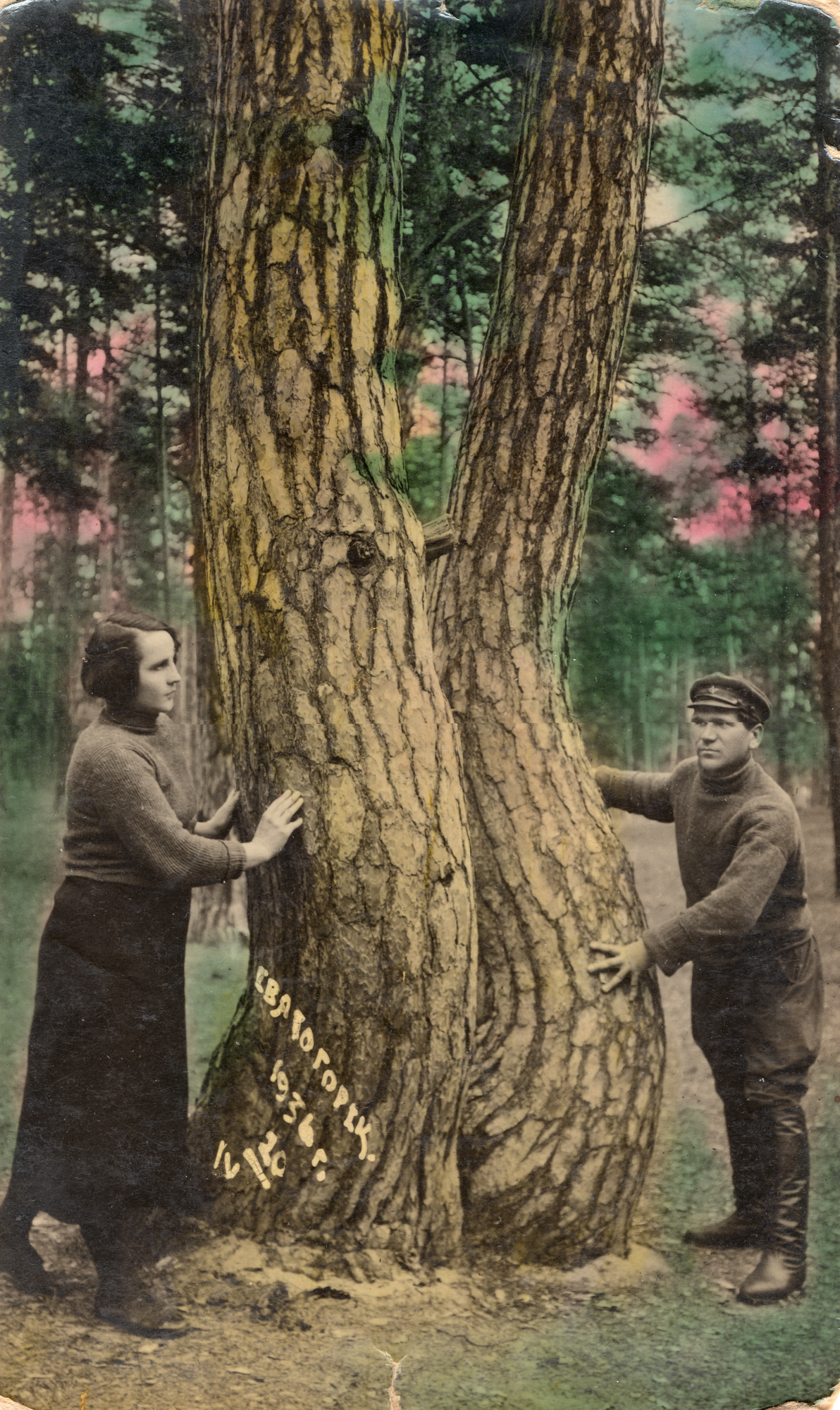
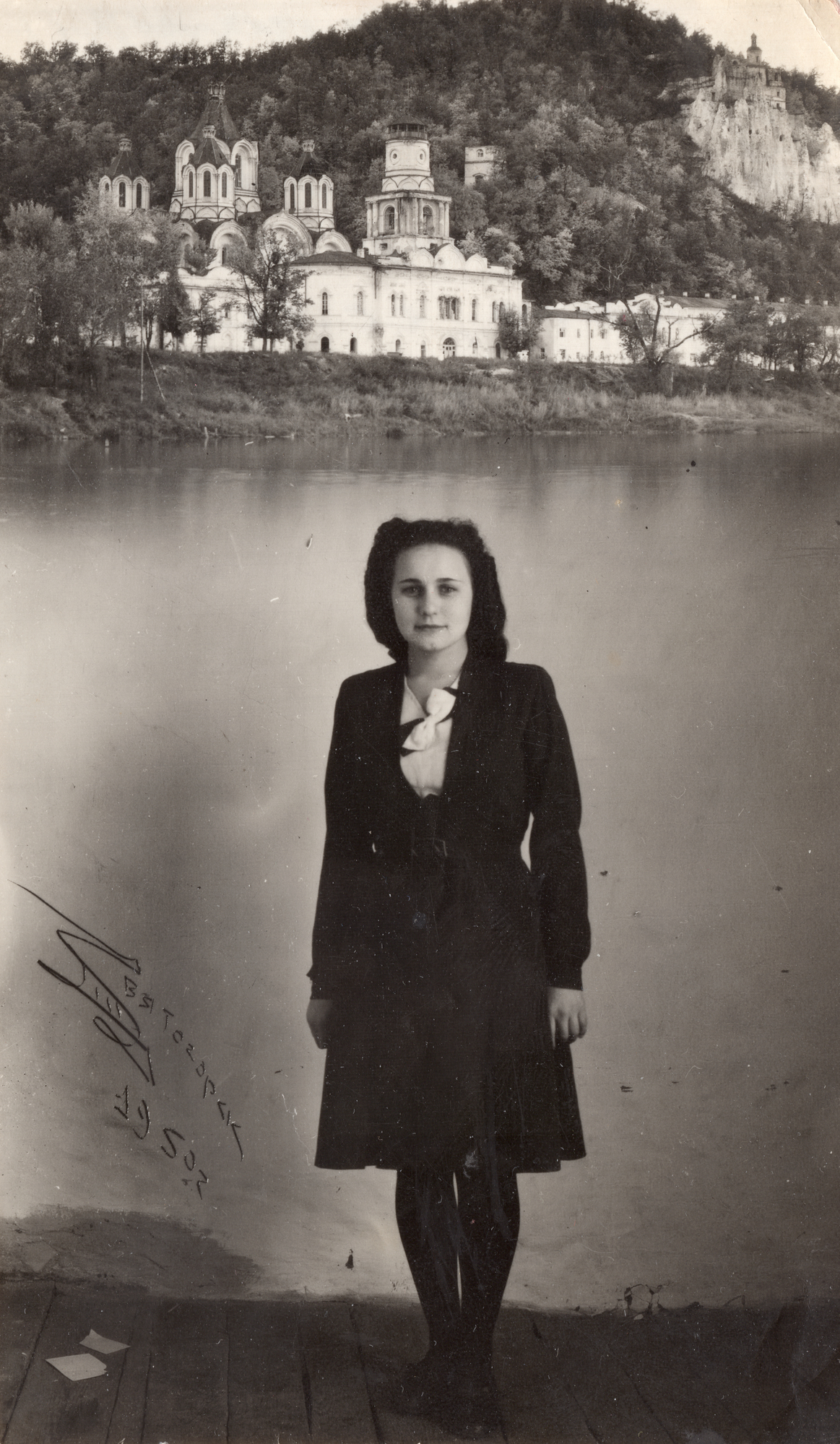
Andrii Dostliev’s “Death of Lucretia” is a speculative and playful outcome of the long-standing research into a collection of commercially produced tourist photographs from the small town of Svitohirsk in the Donetsk region in the East of Ukraine. A local photography studio has been serving the tourists visiting a local resort. Over the decades, it has produced an infinite number of images employing various techniques of photo-manipulation and collaging, combining the group tourist photographs with the views on the local landmark, Sviatohirsk monastery. The artist proposes viewing those practices as ‘vernacular modernism’, which existed in indirect opposition to the official modernist project of the Soviet state. His exploration is made in collaboration with contemporary Ukrainian photography researchers and Renaissance paintings.
Lia Dostlieva’s work “Ten faded faces”, like many pieces in this exhibition, turns to the archives of her own family in Donetsk, Ukraine. However, in Lia’s case, the central issue lies precisely in the absence of a family archive – the lack of photographs, documents, and records – compounded by a Soviet-era habit of silence, the fragmentation of relatives’ memories, and the nature of individual memory, which over time unconsciously reshapes and replaces recollections. The key problem posed in this work determines both its method and medium: a staged, imagined, and speculative video in which memory travels through fragments and traces of recollection. By engaging with the nature of individual memory and how it transforms over time, the work opens broader questions about how political and social circumstances have led to the disappearance of material traces of a once large family history.
In partnership with the National Library of Latvia and researcher Līga Goldberga, we present the selection of photographs from the archive of Latvian photographer Zenta Dzividzinska (1944 – 2011). The House Near the River is a decades-long photographic exploration of life in the Latvian countryside that the photographer started in the 1960s and continued throughout her photographic life. It is a quiet, slow observation of life that, at the same time, stands as a radical practice of a woman photographer working during the Soviet photo-club era. Dzividzinska pursued her photographic career, balancing between what is acceptable and her own artistic direction. She was her own archivist in a space where institutions couldn’t serve her. Līga Goldberga approaches Zenta Dzividzinska’s archive employing a feminist lens to articulate her creative practice, being essentially feminist at the time of non-existent feminist discourse in Soviet Latvia.
In the atrium (on photography stands), we’ll have Everyone Needs Food, a collaborative exhibition by photographer Jane MacNeil, developed through University of Liverpool research, exploring how community food support in Liverpool reflects the realities of cost-of-living pressures, resilience, and lived experience to spark conversation on food insecurity.
Lia Dostlieva’s work “Ten faded faces” and Andrii Dostliev’s “Death of Modern Lucretia” were co-commissioned by the University of Salford and Open Eye Gallery.
This exhibition is produced in partnership with The Liverpool European Festival, University of Salford, National Library of Latvia, Cultural and creative ecosystem of Latvia as a resource of resilience and sustainability.